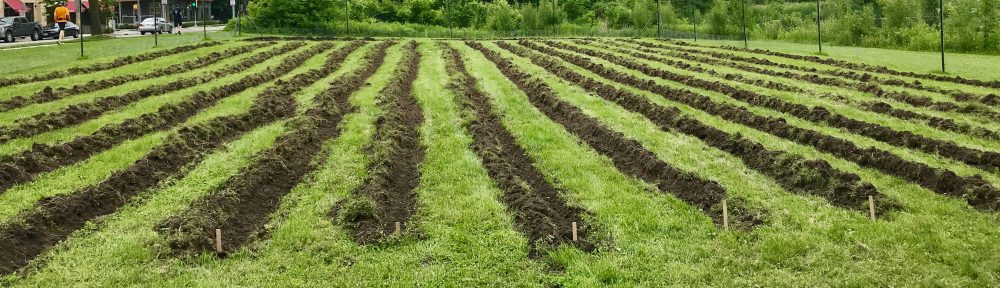
NIFA (National Institute of Food and Agriculture) has $6 million of funding available for efforts addressing critical agricultural water issues like drought, excess soil moisture, flooding, quality and others. Tribal governments, non-profits, educational institutions, and individuals are among the eligible entities. Application deadline for the letter of intent is April 17, 2014 and the final proposal is due August 13, 2014.
Category Archives: Funding Opportunity
Community Food Project (CFP) Grant
USDA’s NIFA (National Institute of Food and Agriculture) is accepting applications for 1) Community Food Projects and 2) Planning Projects to assess food security needs and correlating long-term solutions. Technical Assistance support grants may also be awarded. The maximum awards are $300,000 for CFP and $25,000 for Planning Projects. Applications are due March 31, 2014.
Wallace Center Food Hub Grants
The Wallace Center is accepting applications promoting food hubs. They expect to fund between 15 to 30 applications ranging from $10,000 to $75,000. Deadline to apply is March 30, 2014.
ANA Grants
The Administration for Native Americans (ANA), which is part of the US Department of Health and Human Services is currently accepting applications in five different areas. Food and agriculture projects probably best fit under the economic development related areas. Applications, which are due April 15th, may be up to $500,000 and can last multiple years. Here is a list of past grant awards.
USDA Farm to School Grants
USDA announced the availability of farm to school grants this week. The application deadline is April 30, 2014 and there are three types of grants 1) planning, 2) implementation, and 3) support service.
First Nations Youth Grant Opportunity
Another First Nations Development Institute grant opportunity is available with their Youth and Culture Fund for projects aimed at addressing a variety of social issues. Approximately 20 grants ranging between $5,000 and $20,000 will be awarded. The application deadline is March 20th, 2014.
First Nations NAFSI Grant Opportunity
First Nations Development Institute (FNDI) is currently accepting applications as part of the Native American Food System Initiative (NAFSI) for projects aimed at promoting elderly nutrition. Projects encouraging intergenerational learning will be given additional consideration.
FNDI expects to make between four and five awards at a maximum amount of $25,000. The application deadline is March 14th. More information and the online application are available at http://www.firstnations.org/grantmaking/2014nafsi.
USDA Value Added Producer Grant (VAPG)
The Value Added Producer Grant (VAPG) through USDA’s Rural Development is currently accepting applications until February 24th for efforts aimed at assisting producers enter into value added production. Approximately $10 million is available on a competitive evaluation basis, so successful applications must receive as many points as possible.
Notable for the 2014 round of VAPG funding, the maximum levels have decreased to $75,000 for planning grants that fund feasibility studies and to $200,000 for working capital implementation grants.
The Intertribal Agriculture Council can provide assistance on these developing applications and we do have matching fund assistance through generous support from the Shakopee Mdewkanton Sioux Community for projects in the Great Lakes and Great Plains Regions. Contact dan at indianaglink.com for more information on assistance.
First Nations NAFSI Grants
First Nations Development Institute is currently accepting applications for their Native American Food Systems Initiative (NAFSI). Native-controlled non-profits and community-based organizations are eligible to apply for up to ten $37,500 awards. The application deadline is December 6th, 2013. Check the First Nations 2014 NAFSI announcement page for full details.
SARE Youth Educator Grant
The USDA NCR-SARE Youth Educator Grant is accepting applications until October 24th for projects for projects assisting youth educators in research, demonstration, and learning about sustainable agriculture.